Message
From Machine to Life
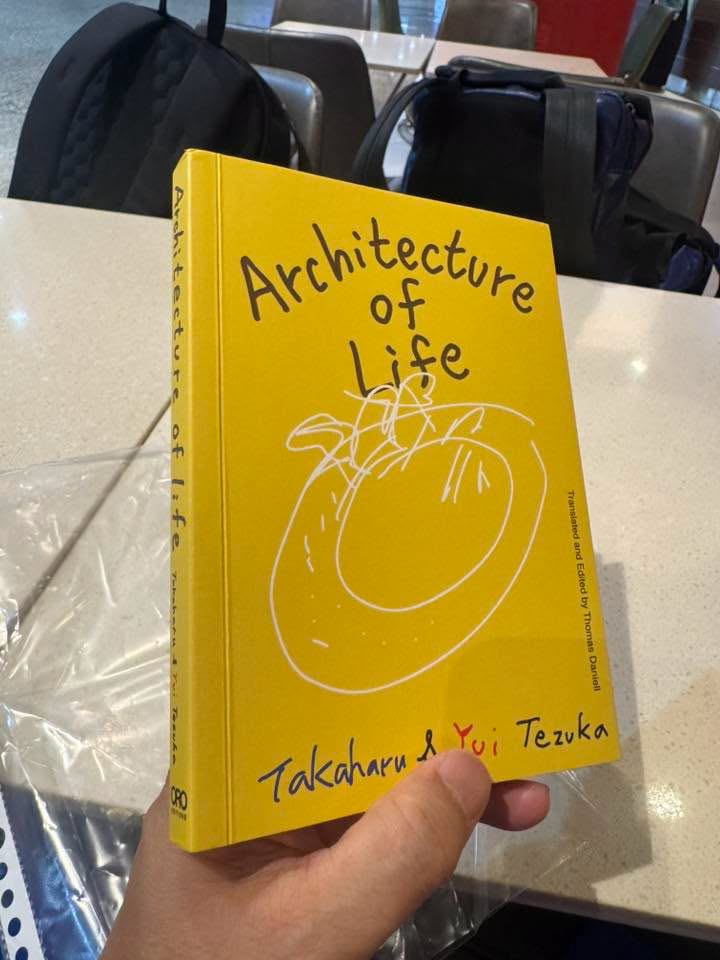
2026/6/18A Reflection on the Back Cover Text of Architecture of Life
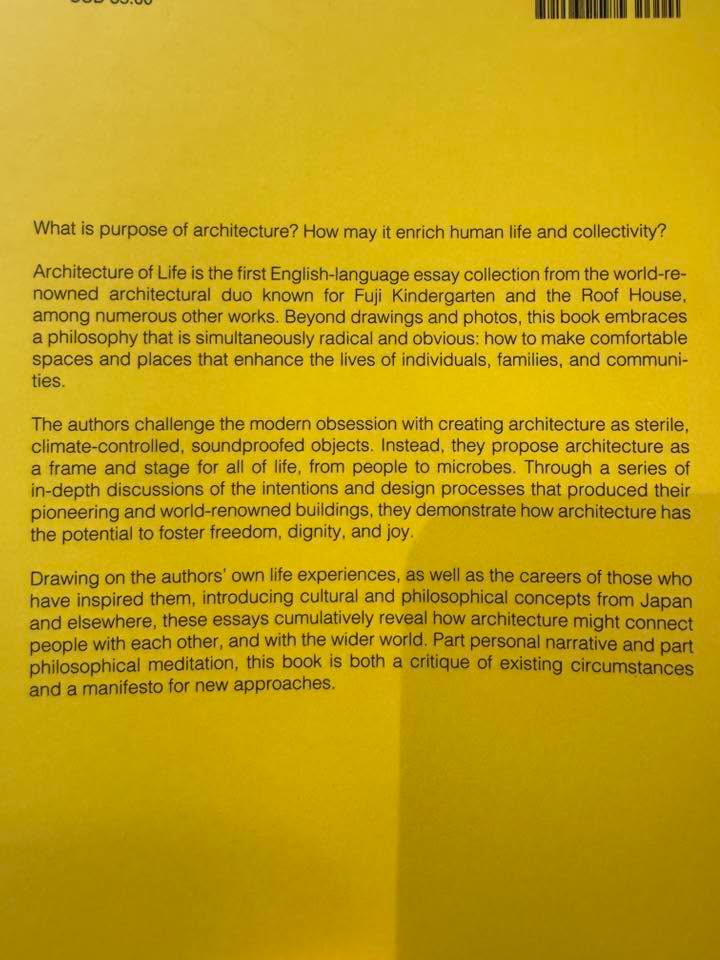
Reading the text on the back cover of Architecture of Life, one is immediately struck by the fact that the book does not attempt to explain architecture from within architecture itself. Architects usually begin by discussing space, form, structure, material, or urbanism. This text takes a different path. Before asking what architecture is, it asks what architecture is for. Its opening questions—“What is the purpose of architecture?” and “How may it enrich human life and collectivity?”—place architecture within the broader context of human existence. Architecture is not presented as an autonomous artistic or technical discipline, but as a fundamental act that shapes the way people live together in the world.
This position is, in fact, a minority position within the trajectory of modern architectural thought. Le Corbusier spoke of the machine. Mies van der Rohe spoke of order. Postmodernism spoke of meaning. Digital architecture speaks of form generation. Each of these movements, in its own way, was concerned with architecture itself. Yet Architecture of Life begins elsewhere. Its primary concern is not architecture, but life. It asks how architecture can enrich human existence, nurture communities, and contribute to happiness. In that sense, the book initially appears profoundly human-centered.
What makes the text particularly intriguing, however, is that this human-centered perspective quickly reveals itself to be something more complex than conventional humanism. The authors criticize the modern obsession with creating architecture as sterile, climate-controlled, soundproofed objects. This is a remarkable statement. If architecture’s sole purpose were to maximize human comfort, such environments would represent the ultimate achievement. They eliminate inconvenience, unpredictability, and exposure to the outside world. Yet the authors regard this condition with skepticism. Beneath their critique lies a deeper concern: that in protecting humanity from nature, modern architecture may also have separated humanity from the world itself.
This concern becomes even more explicit in the book’s description of architecture as a “frame and stage for all of life, from people to microbes.” This may be the most important sentence on the entire back cover. It is rare to encounter microbes in an architectural manifesto. Their appearance here signals a profound shift in perspective. Architecture is no longer understood as something created solely for human beings. Instead, it becomes a setting in which multiple forms of life coexist and interact. The human subject remains important, but it is no longer isolated at the center of the universe.
At this moment, the book quietly moves beyond humanism. It begins with the question of human flourishing, yet arrives at a vision of life as an interconnected whole. Happiness is no longer defined as living within a perfectly controlled environment. Rather, it emerges through relationships—with other people, with nature, with climate, with time, and ultimately with the larger web of life. Architecture therefore becomes not a shell that isolates us from the world, but a medium that reconnects us to it.
There is something deeply resonant here with Japanese conceptions of nature. Modern Western thought often frames the relationship between humanity and nature as a form of opposition. Architecture becomes a device for protection, and its success is measured by the degree to which it can separate interior from exterior. Traditional Japanese architecture, by contrast, frequently sought to blur such boundaries. The engawa, neither fully inside nor outside, exemplifies this sensibility. Light, wind, rain, and seasonal change are invited into daily life rather than excluded from it. The philosophy expressed in Architecture of Life can be read as a contemporary reinterpretation of that attitude.
For this reason, the text on the back cover functions as far more than a promotional summary. It is a subtle critique of contemporary architectural culture and, at the same time, a declaration of an alternative vision. The central question is not what architecture represents, but what relationships it makes possible. Architecture is understood not as a finished object, but as a field of connections between people and people, people and nature, and people and society.
Seen in this light, the title Architecture of Life acquires a deeper meaning. It does not simply refer to architecture that serves life. Rather, it suggests architecture that participates in life itself. Architecture is not a static object but a living framework through which light, wind, time, and human activity continually interact. It is not a container for life; it is one of the conditions through which life unfolds.
Ultimately, the most significant contribution of this book may be its attempt to shift the basis on which architecture is valued. Much of twentieth-century architecture was measured by efficiency, functionality, performance, and control. Architecture of Life asks a different question: Have these achievements truly made life richer? By returning architecture to the larger ecology of living relationships, the book proposes an alternative measure of value—one rooted not in performance, but in vitality; not in control, but in connection.
In this sense, Architecture of Life is not merely a collection of projects, nor simply a theory of architecture. It is a manifesto for a different understanding of architecture itself—not as an object to be optimized, but as a living condition through which life unfolds.