Message
From Knowledge to Wisdom
2026/5/26From Knowledge to Wisdom — India, Jhamtse Gatsal, and the Architecture of Sharing
The relationship between India and Takaharu Tezuka should not be understood merely as a case of “international activity” or “humanitarian support.” Rather, it represents an intellectual and philosophical journey through which Tezuka gradually transformed architecture itself — from object to life, from function to relationship, from ownership to sharing. At the deepest level of this transformation lies the civilization of India and the worldview it has cultivated over thousands of years.
Throughout Takaharu Tezuka’s architectural philosophy, one repeatedly encounters ideas such as the circle, emptiness, zero, sharing, and what he calls “Open Monism.” These are not superficial references to Eastern spirituality. They are rooted in a much deeper philosophical structure, particularly in the Indian concept of śūnya — emptiness, or zero.
In Western modern thought, emptiness is usually understood as lack, and zero as the absence of existence. But in Indian philosophy, śūnya does not mean mere nothingness. Rather, it signifies an open state of potentiality before differentiation, a condition in which all relationships can emerge. Emptiness is therefore not the negation of existence, but the fertile field from which existence becomes possible.
This sensibility appears profoundly in Tezuka’s architecture. In Fuji Kindergarten, for example, the center is intentionally left empty. A conventional architect might place a monument or symbolic object there, attempting to stabilize the composition around a dominant core. Tezuka does the opposite. The center remains open. Yet it is precisely this emptiness that allows wind, sunlight, children’s movement, seasonal change, and time itself to circulate through the building. The void becomes not a lack, but the generator of events.
This is less a form of Japanese minimalism than a continuation of the philosophical lineage that traveled from India through Buddhism into East Asia. Tezuka often speaks of zero as a “threshold” or “critical point” where chronological time transforms into qualitative time. Chronos is measurable clock time — the time of modern systems and administration. Kairos, by contrast, is lived time, the moment in which something meaningful happens. Indian cosmology is fundamentally cyclical rather than linear. Festivals, rituals, seasons, birth, death, and renewal all repeat and circulate. The looping circulation found in Tezuka’s architecture — his endless corridors, ring structures, and recursive movement systems — resonates deeply with this cyclical understanding of time.
India also led Tezuka to rethink the very notion of completion. Modern Western architecture has long treated completion as the ideal state of a building. The moment of completion is assumed to be the moment of maximum perfection, after which decline begins. In India, however, cities and sacred spaces rarely appear “finished.” Buildings grow, erode, expand, decay, and are repaired continuously over time. Architecture exists as part of a living temporal process rather than as a frozen object. When Tezuka repeatedly says, “Architecture is a living thing,” this reflects not merely poetic metaphor but a profound affinity with the Indian sense of time and impermanence.
Equally important is India’s polytheistic spatial sensibility. Indian cities do not converge toward a singular order in the manner of modern Western urbanism. Different religions, languages, sounds, smells, and temporalities coexist simultaneously. Yet this multiplicity does not collapse into chaos. Instead, it forms a larger cosmic totality. Tezuka’s idea of “Open Monism” strongly echoes this worldview. The world is one, yet irreducibly plural at the same time. Unity does not erase difference; it contains difference within itself.
This perspective also explains Tezuka’s affirmation of noise and unpredictability in architecture. In his essay “Nostalgic Future,” published in the United Nations report Celebrating Childhood, Tezuka criticizes contemporary society for confining children within clean, silent, perfectly controlled boxes. He argues that children should grow up surrounded by wind, rain, noise, and the presence of others. This is not simply an educational theory. It is an ontological position asserting that human beings should not be separated from the world itself. Once again, this resonates deeply with the Indian understanding of coexistence and interdependence.
One of the clearest manifestations of this philosophy appears in Jhamtse Gatsal Children’s Community in northeastern India. Founded by the Tibetan Buddhist monk Lobsang Phuntsok, Jhamtse Gatsal is not simply an orphanage or school. It is a living community integrating family, spirituality, education, agriculture, ecology, and collective life.
What draws Takaharu Tezuka to this place is not merely compassion for disadvantaged children. Rather, he sees in Jhamtse Gatsal something that technologically advanced societies have largely lost: the essence of education itself.
Modern society is fundamentally organized around the competition of knowledge. Who knows more? Who scores higher? Who solves problems faster? Modern education evolved largely to serve industrial economies and national competition. Humanity accumulated enormous amounts of knowledge, yet gradually lost wisdom — the capacity to live together meaningfully.
At Jhamtse Gatsal, Tezuka sees the opposite structure. Knowledge is not possessed individually but shared collectively. It circulates through the community not as a tool for defeating others, but as a means of enriching everyone. Through this circulation, knowledge transforms into wisdom.
This distinction is fundamental. Knowledge is information. Wisdom is relationship. Knowledge can be accumulated individually. Wisdom can only emerge collectively. Knowledge can be competed over. Wisdom can only grow through sharing.
This insight lies at the heart of Tezuka’s long-standing concept of “Architecture for Sharing.” Sharing, for him, is not merely spatial generosity. It is the essential condition through which humanity may rediscover wisdom.
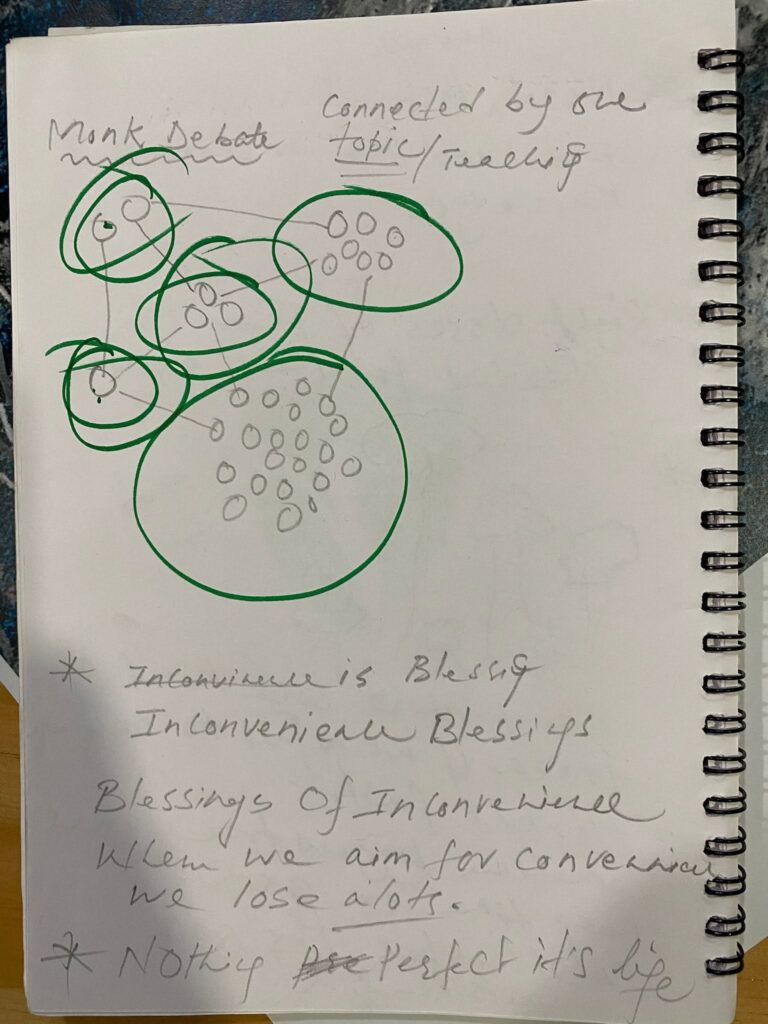
The green circular diagram drawn by Jhamtse Gatsal founder Lobsang Phuntsok makes this visible with remarkable clarity. Unlike conventional school organization charts, the diagram contains no rigid hierarchy. There is no central administrative tree separating principal, teachers, classrooms, and students. Instead, overlapping circles connect fluidly to one another. Most importantly, the diagram states:
“Connected by one topic / teaching.”
In other words, the spaces are not connected by function, but by inquiry and learning itself.
This is deeply significant. Education here is organized not around classrooms, but around dialogue. The structure directly reflects the Tibetan Buddhist tradition of debate and philosophical exchange. In Tibetan monastic culture, debate is not designed to produce winners and losers. It is a collective process through which understanding deepens. Knowledge is not owned; it circulates.
The diagram therefore represents the transformation of Knowledge into Wisdom.
The circles themselves are also revealing. They are irregular, asymmetrical, partially overlapping. They resist complete division. Here one sees what Tezuka describes as the importance of prime-number structures. Prime numbers cannot be divided evenly. They always produce remainders. Modern civilization, by contrast, often assumes that the world can be divided cleanly into oppositions: winner and loser, ally and enemy, rich and poor, right and left. But human existence is never perfectly divisible. There is always remainder, ambiguity, overlap. And it is precisely within this “remainder” that dialogue and coexistence become possible.
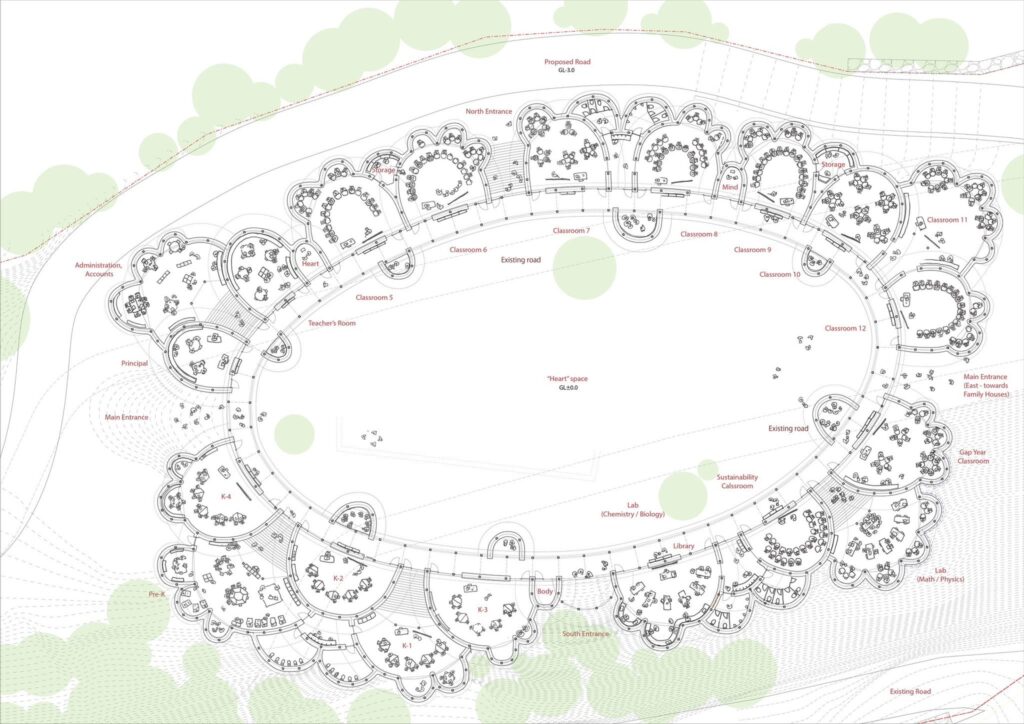
This philosophy becomes architectural in the school’s master plan. The large oval layout contains a central “Heart Space,” yet this center is not authoritarian or controlling. Around it are clusters of smaller learning communities connected through looping corridors and shared circulation systems. The school is conceived not as a centralized institution but as a constellation of interconnected micro-communities.
This is profoundly different from the logic of modern mass education. Modern schools are organized through standardization: identical classrooms, identical desks, identical schedules. Jhamtse Gatsal instead embraces difference. Yet difference is not used for competition. It is used for sharing.
Even the labels embedded in the plan — “Mind,” “Heart,” and “Body” — reveal a radically different educational philosophy. Modern education tends to isolate intellectual development from emotional and bodily experience. Here, mind, heart, and body remain inseparable. Education is understood as the cultivation of the whole human being.
The sketches accompanying the project contain phrases such as “Inconvenience is Blessing” and “Nothing perfect, it is life.” These statements express the core of Tezuka’s philosophy. Contemporary society treats convenience as an unquestioned good. Yet convenience often means the elimination of friction, unpredictability, and dependency on others. The more convenient society becomes, the more isolated human beings become.
Jhamtse Gatsal proposes the opposite. It intentionally preserves forms of inconvenience because inconvenience reconnects people. One must walk. One must ask others for help. One must cooperate. Relationship emerges through these frictions. “Inconvenience is Blessing” is therefore not anti-technology rhetoric. It is an environmental philosophy of human connection.
Likewise, “Nothing perfect, it is life” expresses Tezuka’s rejection of total control. Perfect environments, total silence, zero error, complete predictability — these conditions weaken life itself. Life exists precisely through fluctuation, incompleteness, and unpredictability.
What is being designed at Jhamtse Gatsal is therefore not simply a school. It is a transition model from a Knowledge Society to a Wisdom Society.
For Tezuka, creating architecture there is not merely philanthropy. Nor is it simply humanitarian aid. It is an architectural response to one of the deepest questions facing humanity today:
Can civilization move beyond competition toward coexistence?
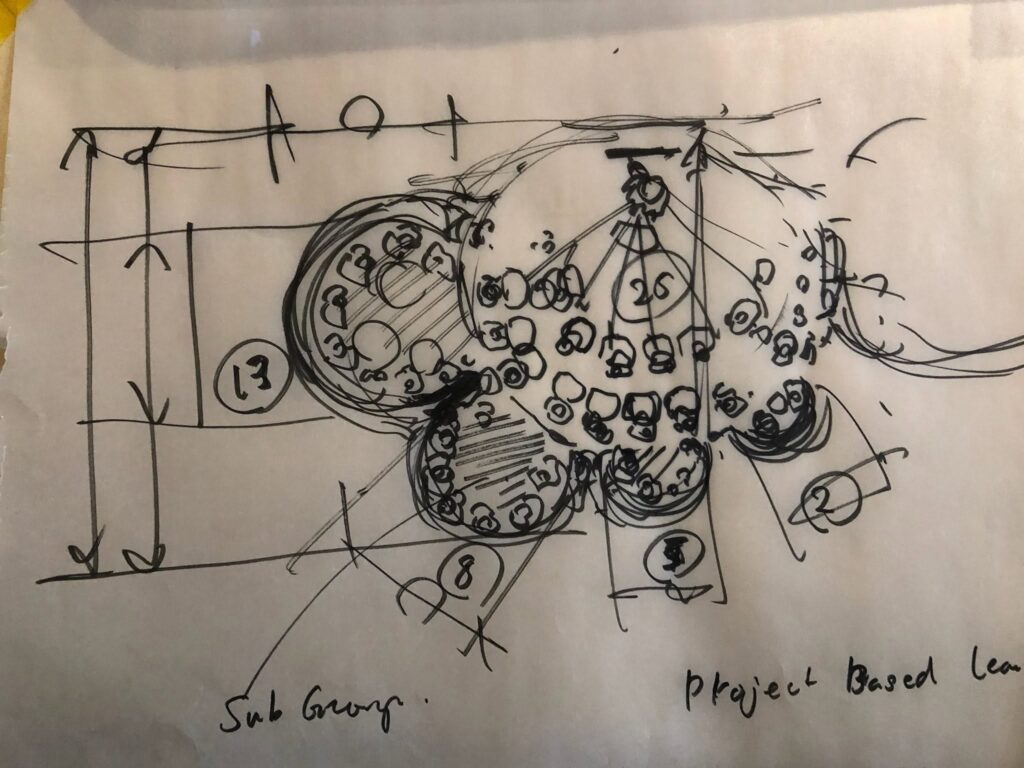
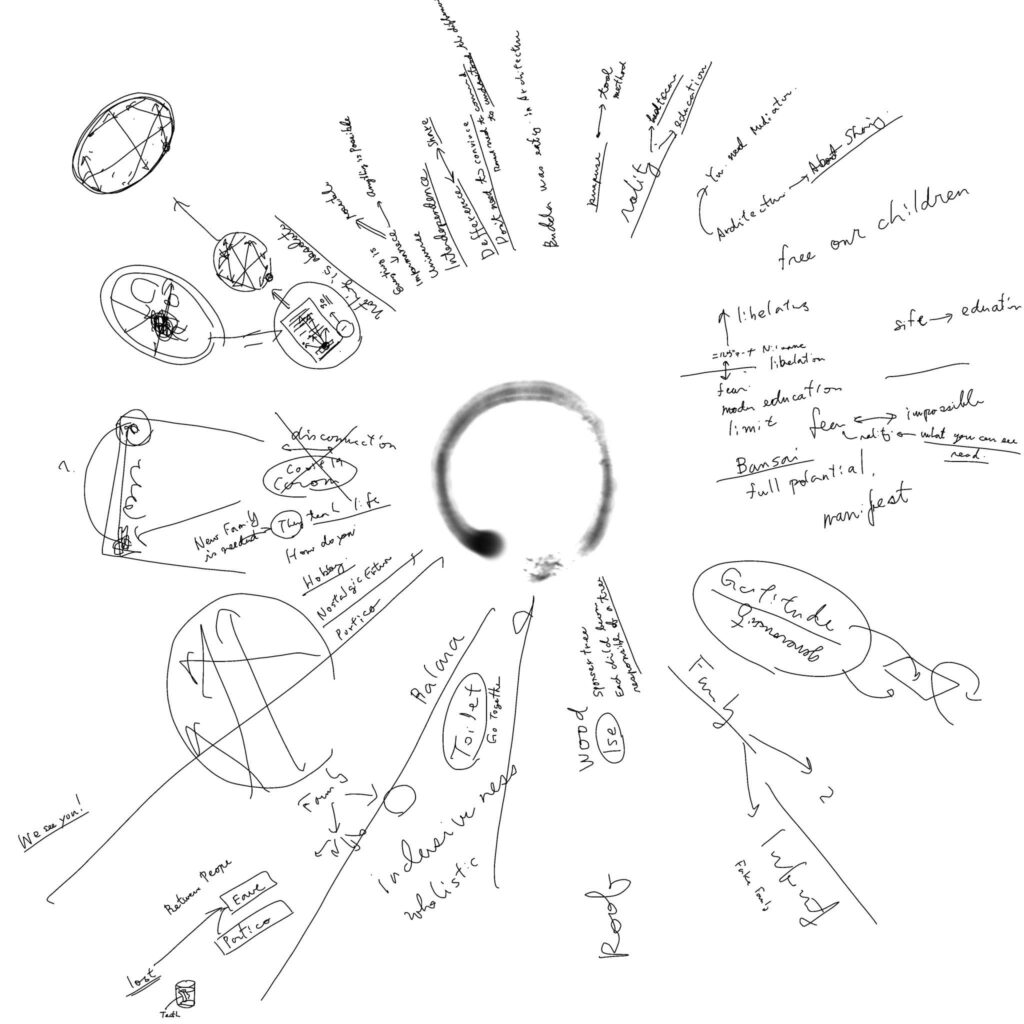
The drawings and sketches associated with Jhamtse Gatsal are therefore far more than design documents. They are records of educational philosophy, community theory, religious thought, environmental ethics, and visions of peace becoming architecture.
At the foundation of all this lies the Indian civilizational understanding of emptiness, cyclical time, coexistence, plurality, and interdependence.
Thus, the relationship between India and Takaharu Tezuka is not merely the relationship between an architect and a country. It is a philosophical journey seeking a transition from a civilization based on competition to one based on sharing.