Message
From Existence to Life
2026/5/26From Existence to Life — Takaharu Tezuka and the Pennsylvania Lineage
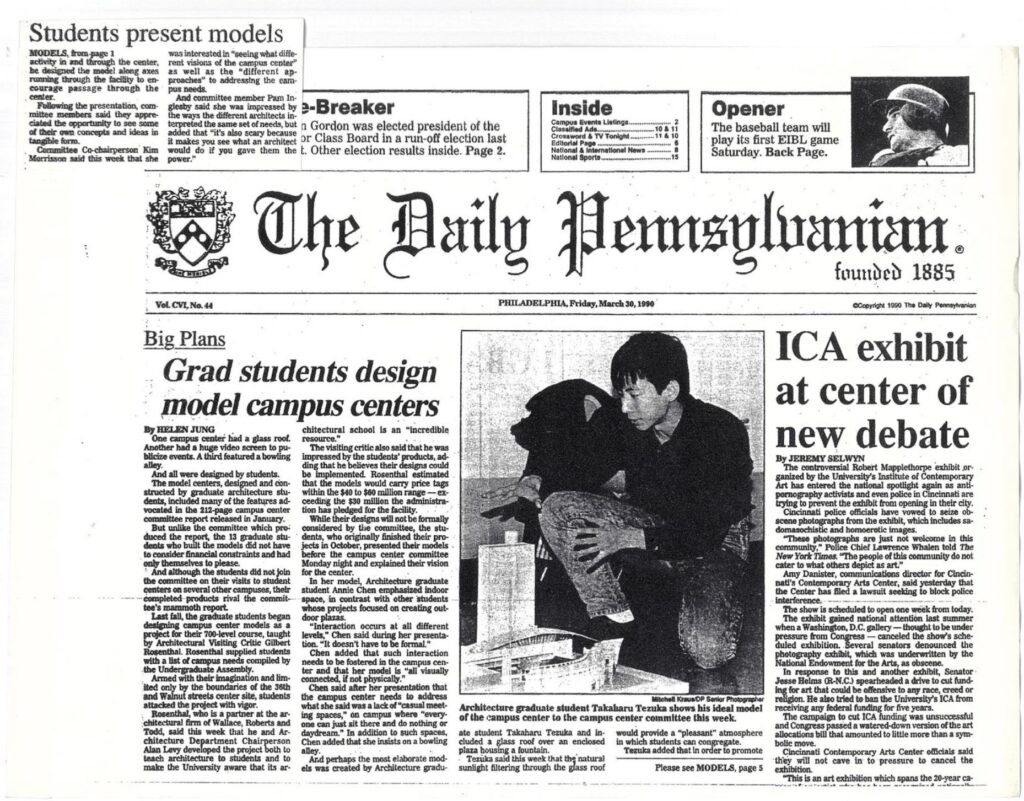
The relationship between Takaharu Tezuka and the University of Pennsylvania cannot be explained merely as the story of a Japanese architect studying abroad. It is, rather, a story about the transformation of architectural thought itself from the late twentieth century into the twenty-first. When Takaharu Tezuka graduated from Musashi Institute of Technology in 1987 and entered the graduate program at the University of Pennsylvania, he was stepping into a place carrying an extraordinary intellectual atmosphere. Philadelphia was not simply another American city. Unlike New York, dominated by finance, or Los Angeles, shaped by endless expansion, Philadelphia retained a dense historical gravity of brick, stone, and institutional memory. Above all, it was the city of Louis Kahn.
Although Kahn had already passed away before Tezuka arrived, his presence still permeated the university. Kahn was not merely a master of monumental concrete forms. His deeper contribution lay in asking fundamental questions about architecture itself. While modernism increasingly pursued efficiency, transparency, and functional rationality, Kahn returned to more essential concerns: light, silence, gathering, memory, and existence. His famous question, “What does a building want to be?” was not poetic rhetoric but an attempt to restore architecture as something more than an engineered object. For Kahn, architecture possessed a kind of inner necessity; it was a place where human beings gathered to think, learn, pray, and exist together.
At the University of Pennsylvania, Tezuka entered an environment where these questions were still alive. He did not study directly under Kahn, yet he inherited a culture shaped by Kahn’s intellectual legacy. More importantly, Tezuka absorbed not the stylistic language of Kahn but his method of questioning. This distinction is crucial. Tezuka did not become a formal imitator of Kahn’s monumental geometry. Instead, he inherited a way of thinking about architecture as an existential condition.
The teachers surrounding him were themselves deeply influential figures in contemporary architectural discourse. Mohsen Mostafavi, who would later become Dean of the Harvard Graduate School of Design, was among the leading voices redefining architecture through ecology, urbanism, and landscape. Mostafavi did not treat architecture as isolated objects but as part of larger social and environmental systems. Alongside him, David Leatherbarrow developed an architectural theory centered on time, weathering, topography, and environmental relations. Their influential book On Weathering fundamentally challenged the modernist obsession with pristine completion.
Modern architecture had long privileged the image of the newly finished building. Architecture was judged at the moment of completion, after which decline supposedly began. Leatherbarrow and Mostafavi overturned this assumption. For them, architecture only truly enters the world through exposure to time, rain, sunlight, erosion, human use, and environmental change. Buildings become meaningful through weathering.
This intellectual framework resonates profoundly with Tezuka’s later philosophy. For decades, Tezuka has repeatedly described architecture as “a living thing.” Buildings are not complete at the moment of construction. They become architecture through children running across floors, through wind passing through rooms, through sound reverberating, through surfaces aging, and through memories accumulating over time. Architecture is not a static object but part of a living ecosystem.
This philosophy appears most vividly in Fuji Kindergarten. Conventional educational facilities prioritize control, silence, efficiency, and supervision. Fuji Kindergarten reversed these priorities. Children run freely across the circular rooftop. Wind flows continuously through the open classrooms. Trees penetrate the building itself. Boundaries between inside and outside remain deliberately ambiguous. The project rejects excessive environmental control in favor of bodily engagement with the world. This was not simply an aesthetic gesture. It represented a fundamentally different understanding of architecture itself.
Yet the relationship between Tezuka and the University of Pennsylvania extends beyond his personal education. There exists a broader Japanese lineage connected to Penn and to Kahn. One important figure is Chiaki Arai, Tezuka’s senior at Musashi Institute of Technology and later one of his mentors. Arai graduated from the University of Pennsylvania and worked in Louis Kahn’s office. During Tezuka’s student years, Arai taught as a part-time instructor. Decades later, after Tezuka himself became a professor at Tokyo City University, he invited Arai to join the university as a full-time professor. This was more than a personnel decision; it symbolically reintroduced the Kahn lineage back into Japanese architectural education.
Another significant figure was Hisao Koyama, former chair of architecture at the University of Tokyo. Koyama had also studied at the University of Pennsylvania under Kahn. Through alumni gatherings, Tezuka came into contact with Koyama, revealing that Penn functioned not merely as an educational institution but as a transgenerational intellectual network united by a shared understanding of architecture as existential practice.
Interestingly, this network extended beyond architecture itself. Sukemasa Kabayama, a friend of Tezuka from Penn, studied environmental design there before later becoming CEO of Lego Japan and Tesla Japan. Penn therefore represented not only architecture but a broader interdisciplinary culture linking design, education, technology, and society.
After Penn, Tezuka moved to London to work for Richard Rogers. Rogers had studied at Yale, where he encountered Kahn’s influence during his own education. Thus Tezuka experienced Kahn’s legacy twice: first directly through Penn, and then indirectly through Rogers. Yet what is remarkable is that Tezuka did not continue toward Kahn’s monumental solemnity. Instead, he moved toward children, play, sound, wind, openness, bodily movement, and shared experience.
Kahn’s spaces are often silent and monumental. Tezuka’s spaces are noisy, filled with laughter, footsteps, wind, and unpredictability. Yet beneath these differences lies a shared concern: architecture as a place supporting human existence. Tezuka did not reject Kahn; he transformed Kahn’s existential architecture into something more bodily, ecological, and alive.
This transformation becomes especially visible through Tezuka’s continuing relationship with Mohsen Mostafavi. Mostafavi wrote the foreword to the well-known “Yellow Book,” the monograph on Takaharu and Yui Tezuka published by JOVIS Publishers . The content emerged from lectures Tezuka delivered at Harvard GSD. Mostafavi interpreted Tezuka’s work not as a uniquely Japanese curiosity but as a critical model for the future of architecture. He framed Tezuka’s work as “Architecture for Sharing,” emphasizing relationships, participation, openness, and collective experience.
Mostafavi’s own theoretical work—especially around ecological urbanism and post-object architecture—deeply aligns with Tezuka’s projects. In Tezuka’s architecture, buildings are not isolated objects but environments enabling relationships between people, nature, and time. Fuji Kindergarten and PLAY! PARK are not simply buildings; they are social and ecological frameworks for human interaction.
This intellectual trajectory culminates symbolically in Tezuka’s upcoming recognition by the American Institute of Architects as an Honorary Fellow (Hon. FAIA). This distinction is among the highest honors granted to non-American architects and places Tezuka alongside figures such as Kenzo Tange, Fumihiko Maki, Arata Isozaki, and Yoshio Taniguchi.
However, the significance of this honor extends beyond personal achievement. Historically, the AIA has represented professional authority, technical expertise, institutional organization, and large-scale urban practice. That such an institution now honors Tezuka—whose work centers on children, play, wind, vulnerability, openness, and bodily experience—suggests a larger transformation within architecture itself.
The priorities of twentieth-century architecture—control, perfection, efficiency, environmental isolation, and technological mastery—are gradually giving way to new concerns: coexistence, ecology, sharing, embodiment, and life itself.
This shift is embodied in the English publication of Tezuka’s book Architecture of Life, released simultaneously with the AIA Honorary Fellowship. The book is not merely a portfolio but a philosophical statement developed over decades. It argues that architecture should reconnect human beings with the natural world rather than isolate them from it. Excessive environmental control weakens human experience. Buildings should not become sealed containers but permeable membranes between people and the world.
Significantly, Mohsen Mostafavi once again wrote the foreword for this English edition. This second foreword carries profound symbolic meaning. In the Yellow Book, Mostafavi introduced Tezuka primarily as an innovative practitioner. In Architecture of Life, he presents Tezuka as a mature architectural thinker whose work addresses life, ecology, time, and human existence itself.
Seen in this broader context, the relationship between Takaharu Tezuka and the University of Pennsylvania becomes far more than an educational biography. It forms part of a larger intellectual lineage extending from Louis Kahn through Leatherbarrow and Mostafavi, through Chiaki Arai and Hisao Koyama, through Richard Rogers, and ultimately into Tezuka’s own transformation of architecture into something living, shared, and ecological.
Tezuka’s unique contribution lies in translating architectural philosophy into bodily experience. He did not merely theorize relationships between humans and the environment; he built spaces where those relationships could be physically lived. Through children’s footsteps, through wind, through noise, through weather, through play, architecture itself becomes alive.
That is the deeper significance of Takaharu Tezuka’s international recognition today. He did not export a Japanese style. Rather, he helped recover something modern architecture had gradually lost: the understanding that architecture is fundamentally about life, relationships, memory, and the shared experience of being human in the world.
Photo
Philadelphia, 1990 — Graduate architecture student Takaharu Tezuka presents his campus center proposal at the University of Pennsylvania, where ideas of light, gathering, and openness that would later define his architecture were already emerging.